NotesNovember 2026Planning explained
A 6-metre rear extension needs planning permission in a National Landscape.
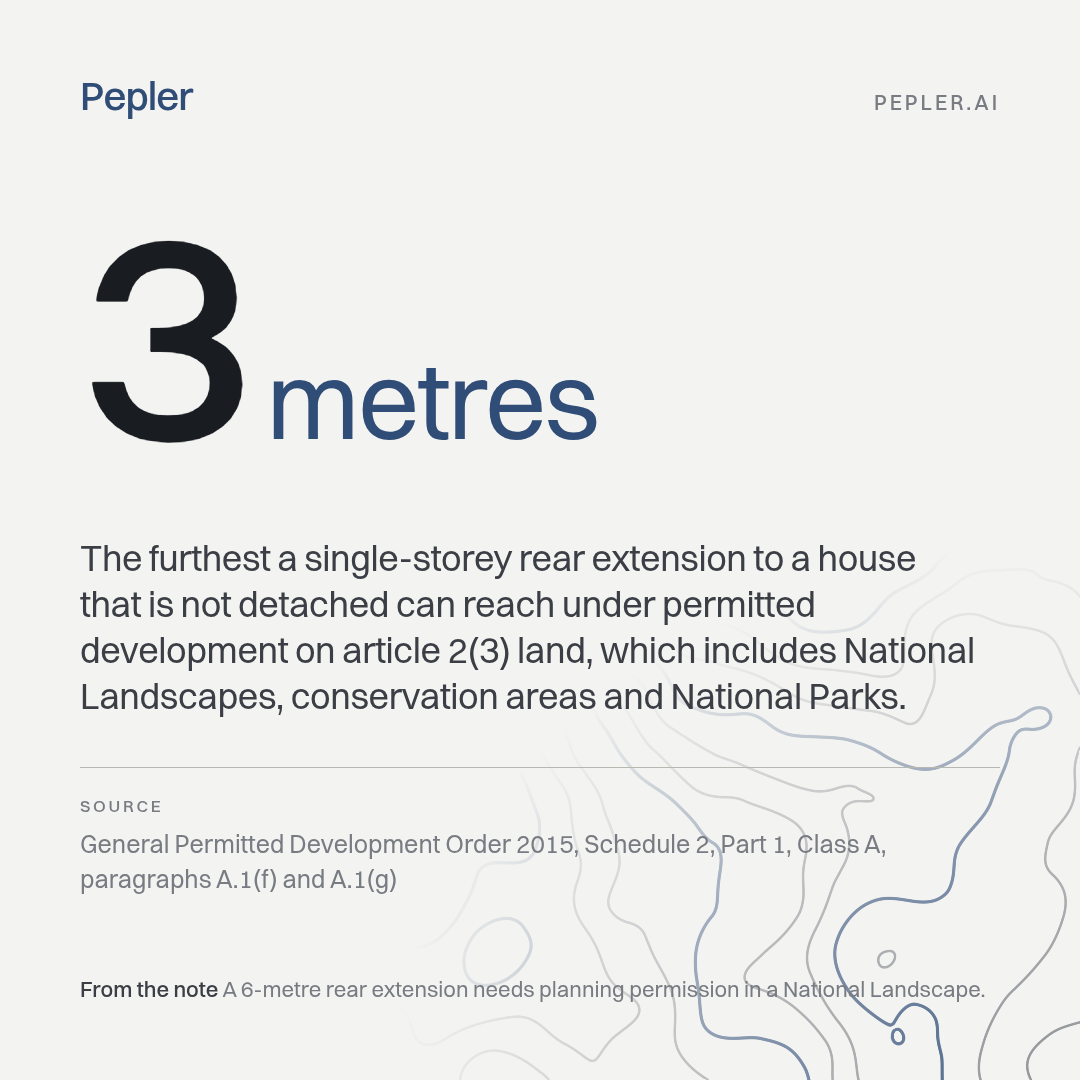
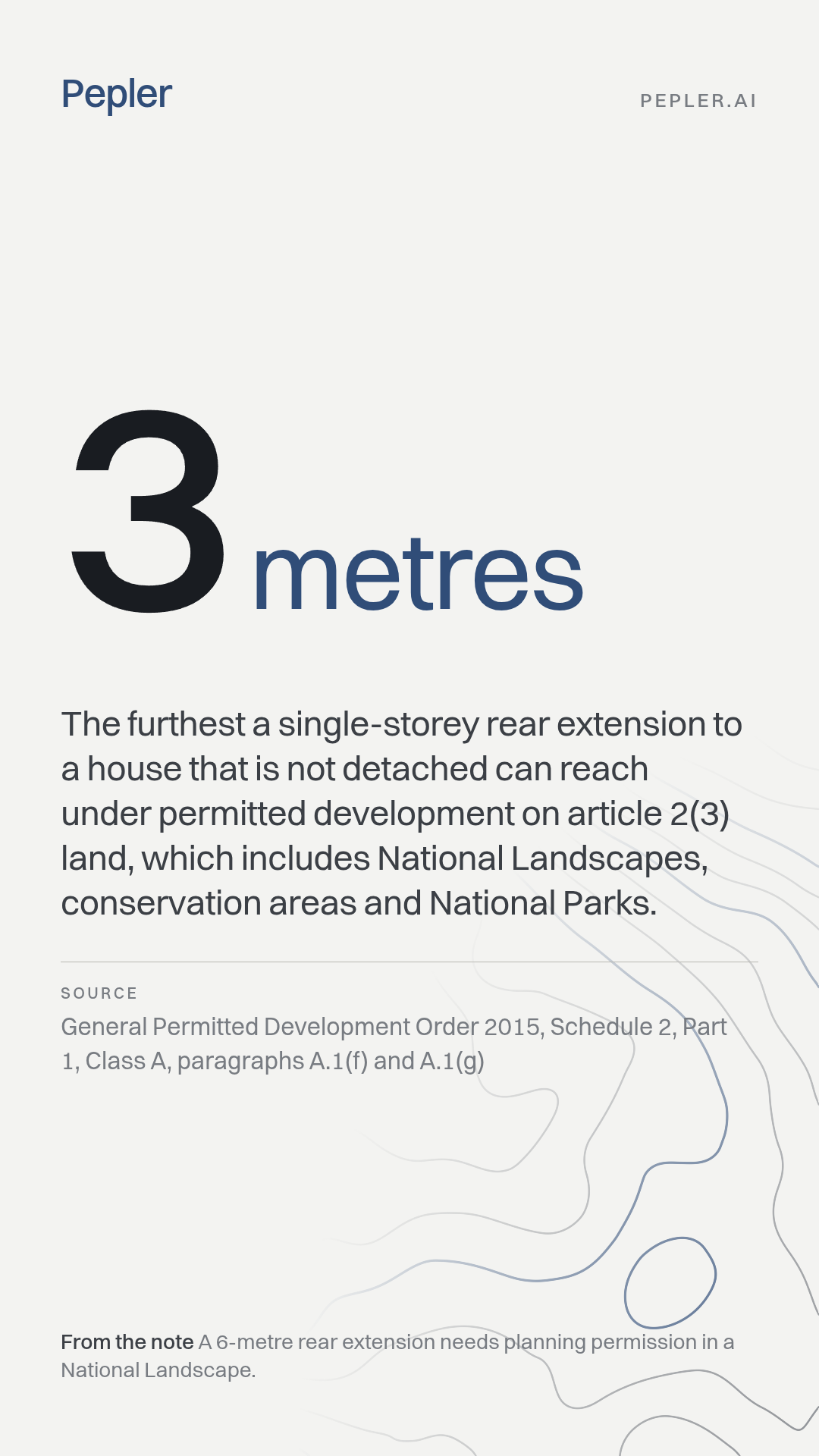
Off protected land, a single-storey rear extension can reach 8 metres on a detached house and 6 metres on any other, through prior approval. On article 2(3) land, which includes National Landscapes, conservation areas and National Parks, the limits are 4 metres and 3.
Two semi-detached houses, one inside a National Landscape and one outside it, have different rights to extend. Outside, a single-storey rear extension can reach 6 metres beyond the original rear wall without an application for planning permission, through the prior approval route known as the larger home extension. Inside, the limit for the same house is 3 metres. A 6-metre extension there needs planning permission. So would one on a detached house, where the limit is 4 metres.
The larger limits stop at article 2(3) land.
Class A of Part 1 of Schedule 2 to the General Permitted Development Order 2015 sets out how far a house can be enlarged without an application for planning permission. For a single-storey rear extension, the standard limits are 4 metres beyond the rear wall of the original dwellinghouse for a detached house and 3 metres for any other house. The extension may be no more than 4 metres high.
Paragraph A.1(g) doubles those depths, to 8 metres and 6 metres. It applies only to a house that is not on article 2(3) land and not on a site of special scientific interest. On any of that land, the standard limits are the furthest permitted development goes.
The furthest a single-storey rear extension to a house that is not detached can reach under permitted development on article 2(3) land, which includes National Landscapes, conservation areas and National Parks.
Source General Permitted Development Order 2015, Schedule 2, Part 1, Class A, paragraphs A.1(f) and A.1(g)
Article 2(3) land is wider than National Landscapes.
Schedule 1 to the Order defines article 2(3) land. It is land within a conservation area, an area of outstanding natural beauty, the Broads, a National Park or a World Heritage Site, or within an area specified under section 41(3) of the Wildlife and Countryside Act 1981. National Landscape is the name now used for an area of outstanding natural beauty. The Order still uses the legal term.
Protected land carries further limits.
On article 2(3) land, paragraph A.2 adds four restrictions to Class A. Cladding any part of the outside of the house in stone, artificial stone, pebble dash, render, timber, plastic or tiles is not permitted. Nor is a rear extension of more than one storey, or an extension beyond a side wall of the original house.
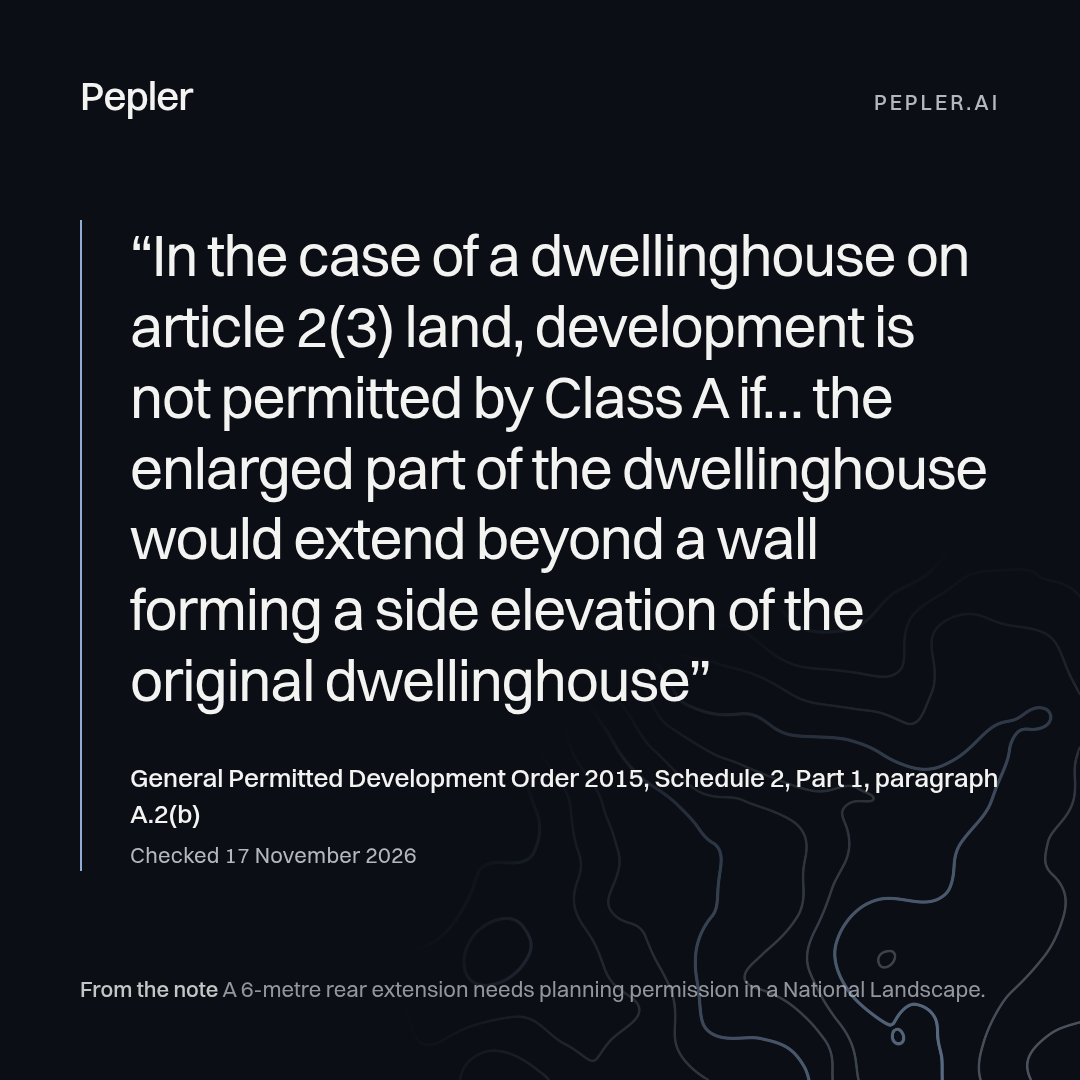
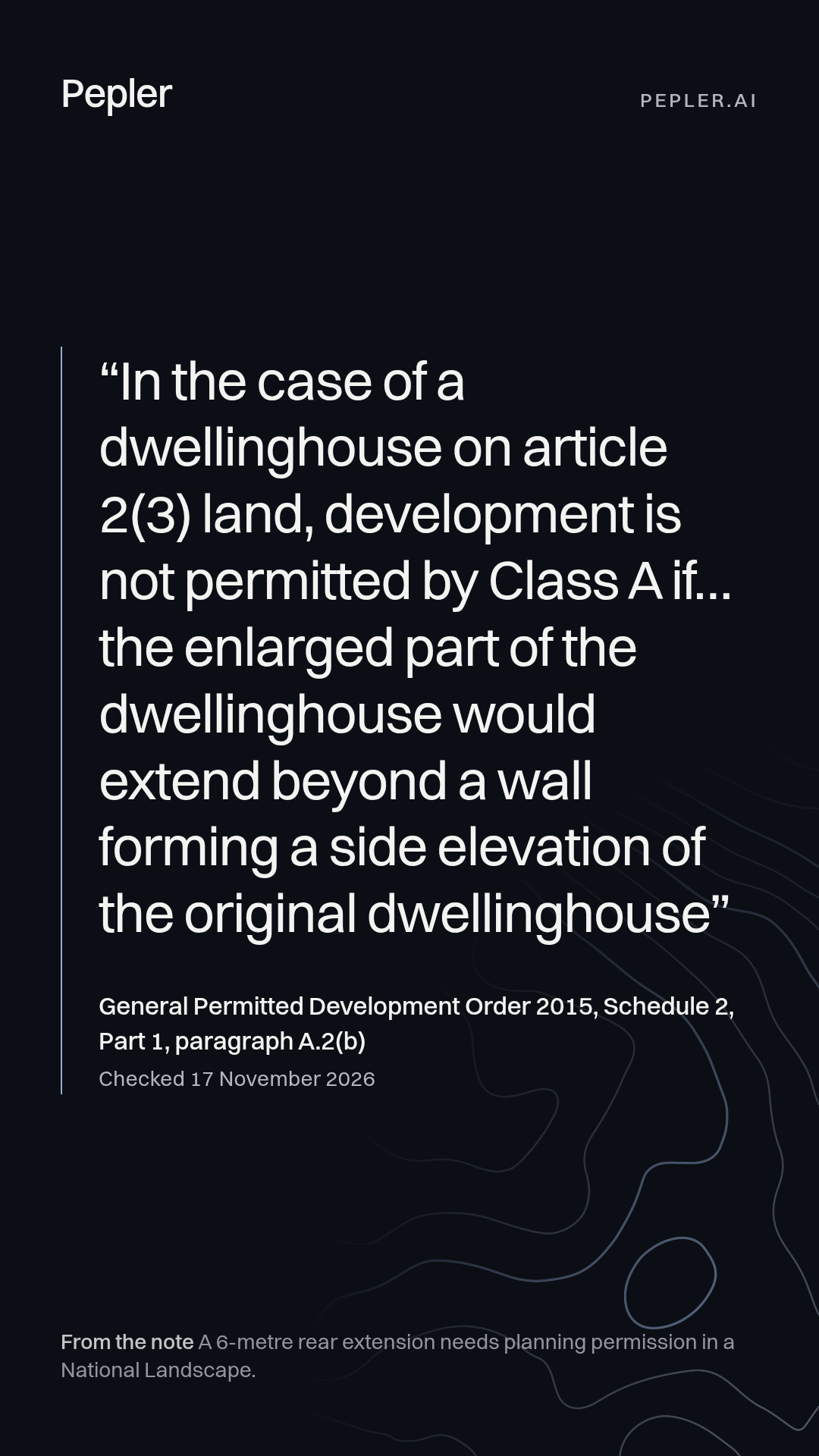
In the case of a dwellinghouse on article 2(3) land, development is not permitted by Class A if… the enlarged part of the dwellinghouse would extend beyond a wall forming a side elevation of the original dwellinghouse
The fourth restriction applies the same limits to the total enlargement, meaning the new extension together with any existing extension it joins.
Depth is measured from the original house.
Every depth runs from the rear wall of the original dwellinghouse. The Order defines original as the building as it existed on 1 July 1948, or as built if it went up after that date.
How the larger home extension works where it applies.
Off article 2(3) land, an extension beyond the standard depths goes through the prior approval process in paragraph A.4. Before work begins, the developer gives the council a written description of the extension, with its depth, maximum height and eaves height, together with a plan, the addresses of adjoining premises and contact details. The council notifies each adjoining owner or occupier and allows at least 21 days for representations. If any of them objects, the council's prior approval is required as to the impact on the amenity of adjoining premises.
Work may begin once the council confirms in writing that prior approval is not required, or gives it. It may also begin after 42 days if the council has not said whether prior approval is given or refused.
Rights can also be removed.
Permitted development rights can be withdrawn for an area or a single property by an Article 4 direction, or by a condition on an earlier planning permission. Where either applies, an extension the Order would otherwise allow needs planning permission too.
Sources: The Town and Country Planning (General Permitted Development) (England) Order 2015, articles 2(1), 3(4) and 4, Schedule 1, Part 1, and Schedule 2, Part 1, Class A, paragraphs A.1, A.2 and A.4, as in force on 3 November 2026. A Pepler answer to this question quoted the Class A and Schedule 1 passages on 21 August 2026, and they were checked again at source on 3 November 2026.