NotesNovember 2026News
Pepler quotes the passage behind every point it makes.
Pepler is AI built for the English planning industry. It answers from planning law, national policy and the development plan, and these notes show what that looks like, one question at a time.

Pepler answers planning questions from the documents that decide them: the Acts and regulations, national policy and the development plan. Each point in an answer comes with the passage it rests on, quoted word for word, with the document and paragraph it came from. Where the documents do not settle a question, Pepler says so.
Planning decisions follow the documents.
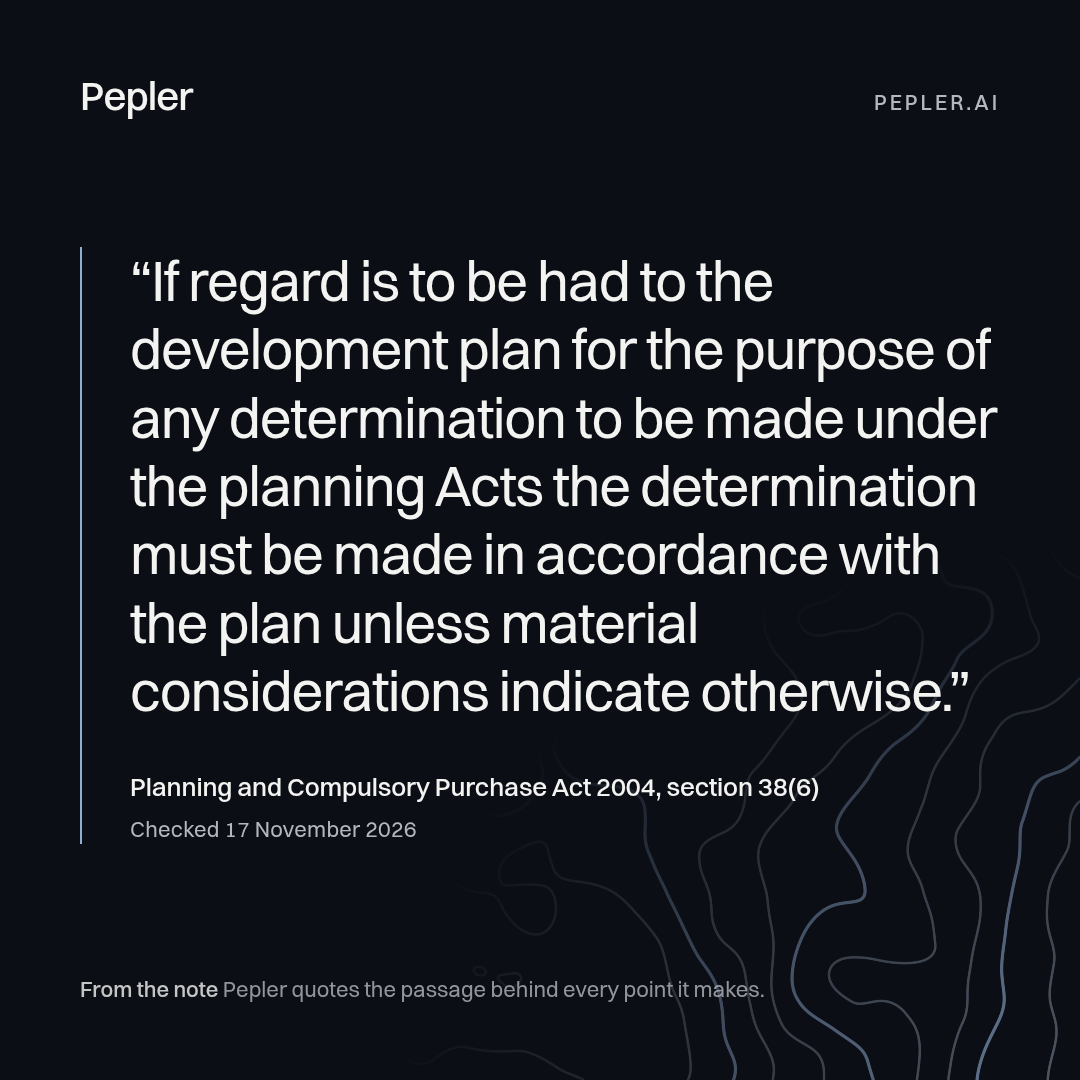
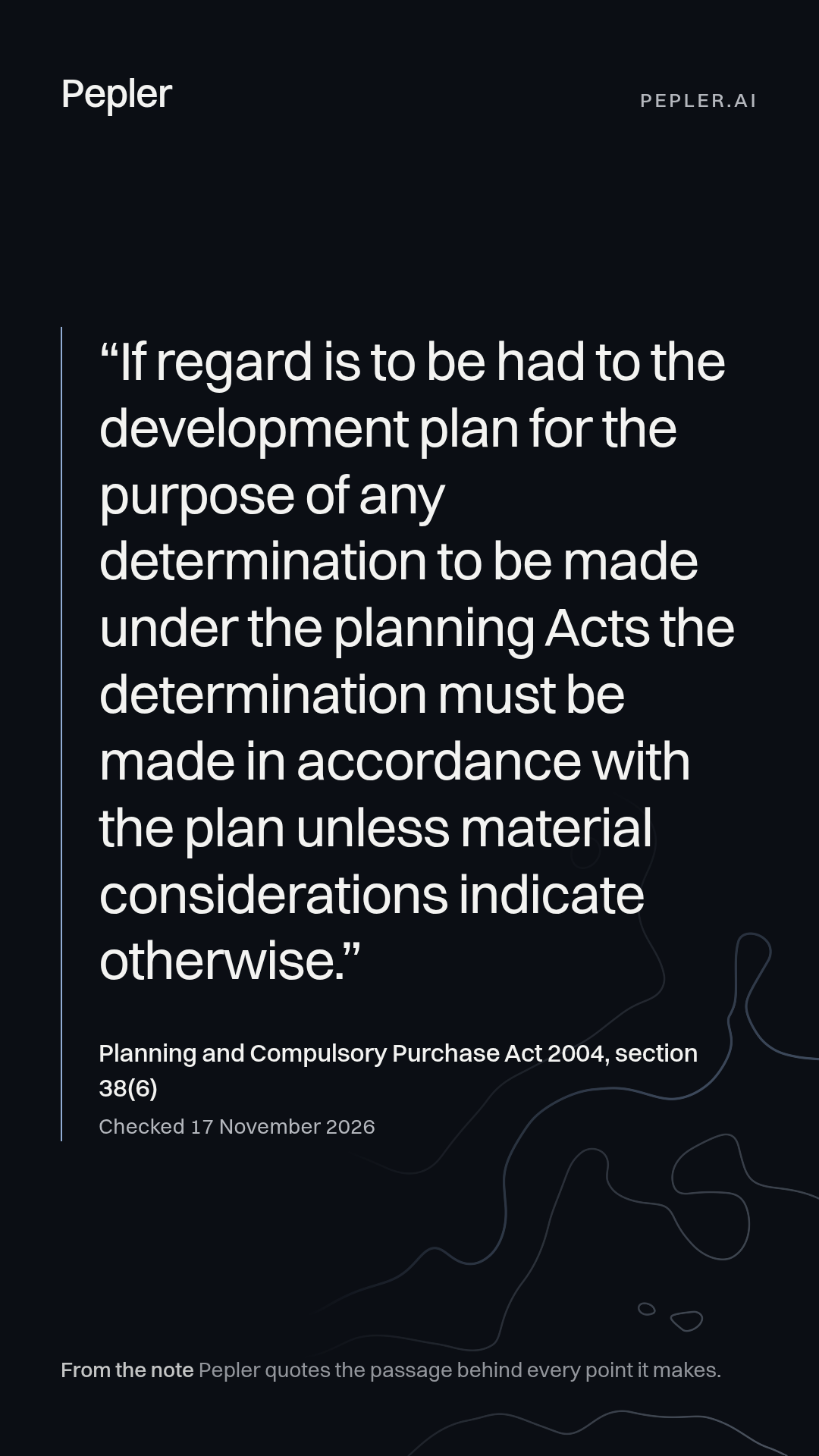
The rule for deciding a planning application in England sits in one sentence of the Planning and Compulsory Purchase Act 2004.
If regard is to be had to the development plan for the purpose of any determination to be made under the planning Acts the determination must be made in accordance with the plan unless material considerations indicate otherwise.
The development plan is a set of documents, and so is national policy. An answer to a planning question is only as sound as the passage underneath it. That is why Pepler puts the passage on the page, where the reader can check the answer against the words that decide it.
The notes work the same way.
These notes take one question at a time and answer it from the documents. The deciding passages are quoted in the text, and the sources are listed at the foot with the date each was checked. The first notes explain the two time limits on an outline permission, the enforcement limits for building work finished before and after 25 April 2024, and how far a rear extension can go in a National Landscape.
When the law or policy behind a note changes after it is published, the note records the change and its source.
The accuracy is published.
No release of Pepler ships until it has passed an accuracy benchmark, a set of hard questions over the whole library, marked against the documents. The latest result is on the benchmark page, and every citation behind it carries the quoted passage and its public source.
The name.
Pepler takes its name from George Pepler, who lived from 1882 to 1959. He was one of the founders of the Town Planning Institute, now the Royal Town Planning Institute, and was its president twice, in 1919 to 1920 and again in 1949 to 1950. He was Chief Town Planning Inspector at the Ministry of Health from 1919 to 1941, then Chief Technical Adviser to the Ministry of Town and Country Planning from 1943 to 1946. He was knighted in 1948.
The University of Strathclyde, which holds his papers, records that he prepared the Town and Country Planning Act 1947, which made planning “an integral role of central and local government”.
Early access to Pepler is open through the early access list.
Sources: the Planning and Compulsory Purchase Act 2004, section 38(6), checked on 17 November 2026; and, on George Pepler, the University of Strathclyde Archives and Special Collections catalogue of his papers.